

What have West Sussex searches taught us about local SEO?
A town page gets you into the queue. How near the front you end up depends on who’s already standing in it. In Portsmouth, that’s a lot of businesses with an actual Portsmouth address, and Google tends to let them go first.
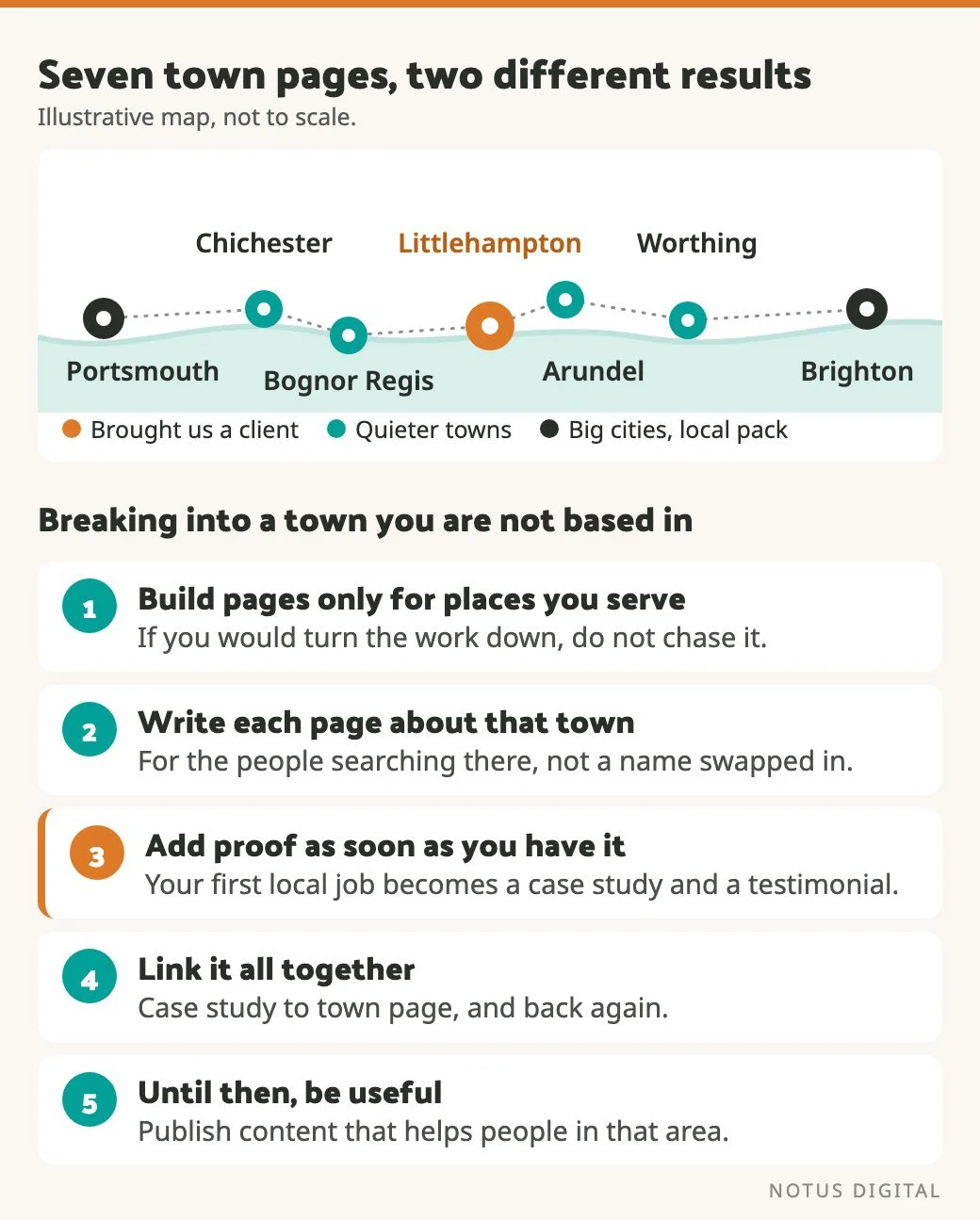
We’ve built web design pages for seven towns and cities near us. In Littlehampton and Bognor they’ve done what we hoped, and one of them brought us a client. In Portsmouth and Brighton they’re still a long way down the results, and rewriting the page hasn’t changed that.
A page saying you serve a town gets you started. Climbing in a crowded area takes proof you actually work there.
The seven town pages we built
We’re based in Bognor Regis. We built a web design page for home, then six more for Chichester, Worthing, Littlehampton, Arundel, Brighton and Portsmouth. Five of them are in West Sussex. Brighton and Portsmouth sit just over the border, in East Sussex and Hampshire, but they’re close enough to count as local for us. Each page talks about its own town. In August we went back and rewrote the Portsmouth page with real local detail, from Southsea to Cosham.
Each town also has at least one blog post aimed at businesses there, answering the sort of questions a local owner might ask. That gives the town page some company, and gives someone who lands on it something useful to read next.
None of this is a trick. In our line of work most meetings happen online anyway, so a business in Worthing can work with us as easily as one round the corner in Bognor. We just want to be in the running when someone nearby searches for what we do. If you genuinely serve a place, a page saying so is fair game.
How the pages are doing
Rankings move about week to week, so treat this as a snapshot from our last checks.
- Littlehampton: on the first page of Google for “web design littlehampton”. This is the page that brought us a client.
- Arundel: on the first page for searches such as “website design in arundel”.
- Bognor Regis: the narrower searches, such as “bognor web design”, sit on or near the first page.
- Chichester: holding around pages three and four.
- Worthing: around page four.
- Portsmouth and Brighton: deeper still, and stubborn with it.
The pages do best where fewer businesses are chasing the same search. Littlehampton and Arundel are smaller places than Brighton, and we’d expect far fewer agencies to be chasing those phrases.
Why Portsmouth and Brighton haven’t moved
Search “web design portsmouth” and, before you reach the ordinary results, you’ll see a map with a handful of businesses pinned to it. That’s the local pack. The businesses in it are nearly always based in or near the city. We don’t have one there, so in practice we’re not getting into it, and work on the website page won’t change that.
We did wonder whether the page itself was the problem. Our Portsmouth and Chichester pages are built the same way, yet Chichester ranks well ahead. The rewrite didn’t move it.
Google’s own guidance points the same way. Its help page on improving your local ranking says local results are mainly based on relevance, distance and prominence. Distance is the one you can’t write your way out of.
Our take, from our own pages: in a competitive area, businesses based there will tend to rank above one trying to break in from outside. We don’t think that’s peculiar to agencies. A Chichester firm trying to win Brighton searches would be up against the same thing.
If you do have premises in a city, the map is very much worth fighting for. Our guide to climbing the Portsmouth map pack covers how.
The search that brought us EarthForce
EarthForce Lightning Protection is a specialist contractor in Littlehampton. When they wanted a new website, they went to Google and searched for web designers in Littlehampton. Our Littlehampton page came up, and they got in touch from there. We built their site and it went live in August.
We’ll admit that’s satisfying. We wrote a page saying we work in Littlehampton, and a Littlehampton business found it. It’s one client, though, so we won’t build a grand theory on it.
Winning the work also gave us proof that we actually work in Littlehampton. There’s now an EarthForce case study on our site, along with a testimonial from the client, and both link to and from the Littlehampton page. The case study is also linked from our work page, and from the service page for the kind of job it was.
The idea is that it all points the same way. When a search engine works out who to show for a Littlehampton search, it can now see a case study, a testimonial and the town name sitting together.
Has it helped yet? Too early to say. The case study went live in mid-September, and when we checked at the start of October the rankings hadn’t improved. Search engines aren’t in any hurry.
What a location page does on its own
Years ago you could add a load of pages, one per town, and rank fairly well with very little on them. In our industry those days are gone. There are a lot of agencies chasing the same towns, and search engines have got much better at telling a thin page from a useful one.
A location page still helps. It tells search engines which areas you cover, and it gives someone searching there a page that speaks to them. We’d treat it as the groundwork and expect nothing dramatic from it on its own.
What we think moves you up from there is evidence you really do serve that area. For us that means case studies about clients there, with a testimonial from each where we can get one. Once you’ve done real work in a town, its name turns up in your content naturally.
The awkward bit is the order it happens in. Proof comes from work, and work in a new area is hard to win before anyone there has heard of you. Breaking into a town is a job in itself.
When we write content with clients, our advice is to write for the person searching. Search engines, and AI tools too, are trying to show the most relevant result. A page that helps someone in that town is more relevant than one that repeats the town’s name in every paragraph.
If you want to be found in a town you’re not based in
This is roughly what we tell clients, and what we’re doing ourselves.
- Only build pages for places you genuinely serve. If you’d turn the work down, there’s no point ranking for it.
- Make each page about that town. Write for the people searching there, with things that are true of that place and of your work in it.
- Add proof as soon as you have it. Your first job in a new area is worth writing up. Ask the client for a testimonial and turn the job into a case study. Mention where the work happened, because it did.
- Link it all together. Case study to town page, town page to case study, and service pages to the case studies for that service.
- Until you’ve broken in, be useful. Publish content that helps people in that area. It won’t win the top spot on its own, but it gets you into the running.
- Keep finding work the traditional way. Search is one route to new clients. Don’t put everything else on hold while you wait for it.
If you are based in the town, make sure your Google Business Profile is set up properly, because that’s what feeds the map. For the groundwork beyond town pages, our guide to getting your business found in your area covers the rest.
What we’ll be watching
Littlehampton is the test. If the case study and testimonial help, it should show in the related searches over the coming months. We’ll write it up either way.
For Portsmouth and Brighton, our answer is that more page work won’t do it. A client in each city, written up properly, is the lever we’re waiting on. Slightly frustrating, but it’s the same advice we’d give anyone else.
If you’d like a second pair of eyes on how your own town pages are doing, get in touch and we’ll tell you what we see.
Questions about local SEO and town pages
In a quieter town, it can. Our Littlehampton page reached the first page of Google with no office there. In busy cities it’s much harder, because businesses based in the area tend to rank above one coming in from outside, and the map results are very hard to get into without a local address.
It’s the map and short list of businesses that appears near the top of Google for many local searches. Google says local results are based mainly on relevance, distance and prominence, so a business with an address in the area has a head start. A good Google Business Profile is what gets you considered for it.
Only the ones you actually serve and can say something useful about. We built seven, all places we work. Search engines have got much better at spotting a page that is just another town’s page with the name changed, and it doesn’t help the person reading it either. Give each one something true about that place.
Our view is that they do, because they show search engines you really work in that area. We’ve just put a case study and testimonial in place for Littlehampton and it’s too early to see a result, so we’ll report back. In the meantime, they help the person reading the page.
There’s no honest fixed answer. It depends on how many businesses are competing for the same search. Our pages for quieter towns do better. Portsmouth hasn’t moved, even after we rewrote the page in August. Track the specific searches in Search Console and judge them over months, not week to week.