

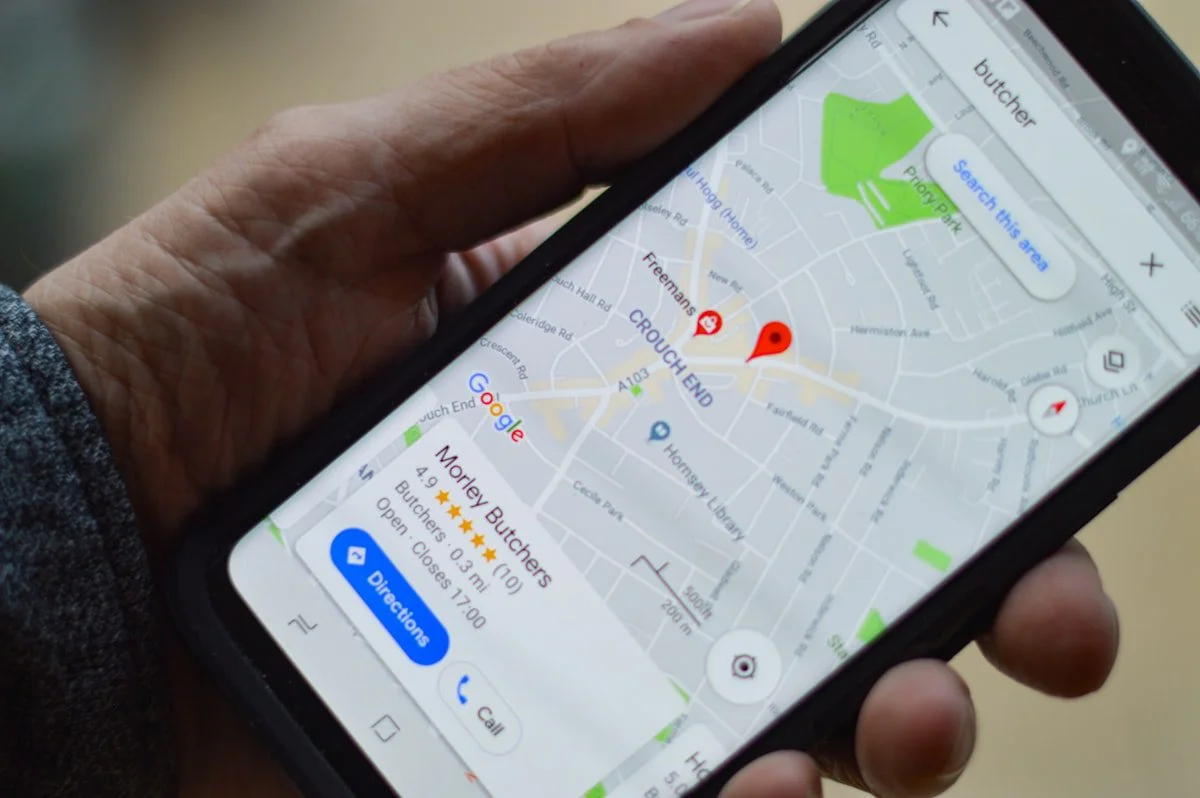
What is local SEO and why should you care?
If you run a business that serves a specific area, whether that’s a town, a county, or a region, local SEO is one of the most important things you can invest time in. It’s the process of optimising your online presence so that your business shows up when people nearby search for the services you offer.
Think about how you search for things yourself. When you need a plumber, you don’t Google “plumber” and hope for the best. You search “plumber near me” or “plumber in Bognor Regis.” That’s local search intent, and Google has become incredibly good at understanding it.
If people can’t find you when they search for what you do in your area, you’re handing business to your competitors on a plate.
According to Google’s own data, searches with “near me” have grown massively over the past few years, and a huge percentage of local searches result in a visit or contact within 24 hours. That’s not just website traffic. That’s actual footfall and phone calls.
We’ve covered broader SEO strategy in our post on moving beyond keyword stuffing, but local SEO has its own set of rules and priorities that are worth understanding separately.
The local pack: Where you want to be
When someone searches for a local service, Google typically shows a map with three business listings underneath it. This is called the “local pack” or “map pack,” and it appears above the regular organic results. Getting into that local pack is the goal for most local businesses because it’s the first thing searchers see.
The local pack pulls its information from Google Business Profiles, so if you haven’t set yours up or optimised it properly, you’re already at a disadvantage. We’ll cover Google Business Profile setup in detail in a separate post, but here’s what you need to know for now: it’s free, and it’s one of the most powerful tools available to local businesses.
Google Business Profile: Your foundation
Your Google Business Profile (GBP) is the cornerstone of local SEO. It’s what powers your appearance in the local pack, Google Maps, and the knowledge panel that appears when someone searches for your business by name.
The basics you need to get right
- Claim and verify your listing if you haven’t already. Google needs to confirm you’re the actual business owner.
- Complete every section. Business name, address, phone number, website, hours, services, description. Leave nothing blank.
- Choose the right categories. Your primary category is important. Pick the one that most accurately describes what you do, then add relevant secondary categories.
- Add photos regularly. Businesses with photos get significantly more clicks and direction requests than those without.
- Use the posts feature. Google lets you publish updates, offers, and events directly on your profile. Most businesses ignore this, which means it’s an easy way to stand out.
Getting your GBP right is such an important topic that we’ll be covering it in much more detail in a dedicated post on setting up and optimising your Google Business Profile.
Local keyword research
Keyword research for local SEO is slightly different from general keyword research. You’re not just looking for what people search for. You’re looking for what people search for in relation to a place.
Types of local keywords
- Explicit local keywords: “Web designer in Chichester,” “plumber Bognor Regis,” “accountant West Sussex.” The searcher includes the location.
- Implicit local keywords: “Web designer near me,” “best plumber,” “emergency dentist.” Google uses the searcher’s location to return local results even without a place name.
- Service + location combinations: These are your bread and butter. Map out every service you offer and pair it with every area you serve.
Action steps for local keyword research
- List all your services and all the towns, cities, and areas you serve.
- Create a matrix of service + location combinations (e.g., “SEO agency Bognor Regis,” “web design Chichester”).
- Use Google’s autocomplete to see what real people are searching for. Start typing your service and see what suggestions appear.
- Check Google Keyword Planner or SE Ranking to get search volume data for your target terms.
- Look at “People also ask” boxes in search results for content ideas related to your local keywords.
If you want to understand how keyword research feeds into your broader strategy, our post on how keyword research transforms strategy is worth a read.
NAP consistency: The boring bit that really matters
NAP stands for Name, Address, and Phone number. It sounds simple, and it is, but getting it wrong can seriously hurt your local rankings.
Google uses NAP information across the web to verify that your business is legitimate and that the information it shows to searchers is accurate. If your business name is “Notus Digital” on your website but “Notus Digital Ltd” on Yell and “Notus Digital UK” on Facebook, that inconsistency creates confusion for search engines.
Your business name, address, and phone number need to be identical everywhere they appear online. Not similar. Identical.
Where to check your NAP
- Your website (header, footer, contact page)
- Google Business Profile
- Social media profiles (Facebook, LinkedIn, Instagram)
- Business directories (Yell, Thomson Local, Bing Places, Apple Maps)
- Industry-specific directories
- Any old listings that might still exist from a previous address or phone number
If you’ve moved premises or changed your phone number, go through every listing you can find and update them. Old, incorrect information is one of the most common local SEO problems we see.
Local citations: Building your digital footprint
A citation is any online mention of your business name, address, and phone number. Citations can be “structured” (in a business directory listing with organised fields) or “unstructured” (a mention in a blog post, news article, or social media post).
Citations help Google verify your business exists and is located where you say it is. The more consistent, high-quality citations you have, the more confident Google is in showing your business in local results.
We’ll be publishing a detailed guide on local citations covering exactly which directories to target and how to audit your existing citations, so keep an eye on our blog for that.
Key citation sources for UK businesses
- Yell.com
- Thomson Local
- Bing Places
- Apple Maps
- Industry-specific directories relevant to your sector
- Local chamber of commerce or business association websites
Reviews: Social proof that Google loves
Online reviews are one of the most influential local ranking factors, and they also directly affect whether someone actually contacts you. Think about it: if you’re choosing between two businesses and one has 47 five-star reviews while the other has 3 reviews with no responses from the owner, which one are you picking?
How to get more reviews
- Ask. Seriously, most happy customers will leave a review if you simply ask them. The best time to ask is right after you’ve delivered a great result.
- Make it easy. Send a direct link to your Google review page. Don’t make people search for where to leave it.
- Respond to every review, positive and negative. It shows you’re engaged and care about customer feedback.
- Never buy fake reviews. Google is getting better at detecting them, and the penalties aren’t worth the risk.
We’ve seen this work brilliantly in specific sectors. Our SEO checklist for dentists covers how review strategies work for service businesses in particular.
On-page optimisation for local SEO
Your website itself needs to signal to Google where you’re located and what areas you serve. This goes beyond just having your address in the footer.
Key on-page elements
- Title tags and meta descriptions: Include your target location in these where it makes sense. “Web Design in West Sussex | Notus Digital” is better than just “Web Design | Notus Digital.”
- H1 and heading tags: Use location-specific headings on your service pages.
- Content: Write naturally about the areas you serve. Mention local landmarks, areas, and specifics that show you genuinely operate there.
- Location pages: If you serve multiple areas, consider creating dedicated landing pages for each one. Each page should have unique, useful content, not just the same text with a different town name swapped in.
- Embedded Google Map: Adding a map to your contact page helps reinforce your location.
- Schema markup: LocalBusiness schema tells search engines exactly what your business is, where it’s located, and how to contact you. More on this below.
If you want to audit your website for these elements, our guide on conducting a website audit walks you through the process.
Local link building
Links from other websites to yours are a major ranking factor in general SEO, and the same is true for local SEO. But for local businesses, the most valuable links tend to come from other local organisations and websites.
Where to get local links
- Local news websites and online publications
- Chamber of commerce or business networking group websites
- Sponsorships: Sponsor a local event, sports team, or charity and get a link from their site.
- Guest posts: Write useful content for local blogs or industry websites.
- Partnerships: If you work with complementary businesses, cross-link where it’s relevant and natural.
- Local PR: Got a story to tell? Local journalists are often looking for content. A new hire, a charity initiative, or an interesting project can get you featured.
The key with link building is quality over quantity. One link from your local newspaper is worth more than 50 links from random directories nobody visits.
Schema markup for local businesses
Schema markup is structured data you add to your website’s code that helps search engines understand your content better. For local businesses, LocalBusiness schema is particularly important because it explicitly tells Google your business name, address, phone number, opening hours, service area, and more.
What to include in your local schema
- Business name, address, phone number
- Opening hours
- Business type (e.g., ProfessionalService, LocalBusiness)
- Service area
- Logo and images
- Social media links
- Reviews and ratings (if applicable)
You can test your schema using Google’s Rich Results Test tool to make sure it’s set up correctly. If this sounds technical, don’t worry. Most WordPress SEO plugins like Rank Math or Yoast can help you implement basic schema without touching code.
Mobile optimisation: Not optional
A huge proportion of local searches happen on mobile devices. Someone’s out and about, they need a service, they pull out their phone and search. If your website doesn’t work well on mobile, you’re losing those potential customers before they even see what you offer.
Make sure your website is fully responsive, loads quickly on mobile connections, and makes it easy to call you or get directions with a single tap.
Tracking your local SEO progress
You can’t improve what you don’t measure. Here are the key metrics to keep an eye on:
- Google Business Profile insights: How many people viewed your profile, clicked for directions, called you, or visited your website.
- Local keyword rankings: Track where you appear for your target location + service keywords.
- Organic traffic from local searches: Use Google Analytics to see how much traffic comes from organic search and which landing pages they’re hitting.
- Review count and average rating: Monitor your reviews across platforms.
- Citation accuracy: Periodically audit your citations to catch any inconsistencies.
Pulling it all together
Local SEO isn’t one single thing you do and forget about. It’s a combination of your Google Business Profile, your website’s on-page optimisation, your citations, your reviews, your links, and your content, all working together to tell Google and potential customers that you’re a legitimate, trustworthy business in your area.
The good news is that most of your local competitors probably aren’t doing all of this well. Many won’t have a fully optimised Google Business Profile. Plenty will have inconsistent NAP information scattered across the web. And very few will be actively building local links or creating location-specific content.
That means there’s a real opportunity to get ahead without needing a massive budget. It just takes consistent effort and a willingness to do the basics properly.
If you want to talk through a local SEO strategy for your business, feel free to get in touch. We work with small businesses across the UK and love helping people get found by the customers right on their doorstep.