

What should a website brief include?
Enough for someone who has never met you to price the job without guessing. If they have to fill gaps with assumptions, you end up comparing those assumptions instead of the prices.
Think about asking three builders to price “an extension”. One quotes for a single room. One prices a two-storey job with bifold doors. The third throws in a new kitchen. You end up with three numbers that have nothing to do with each other, and no way of telling which one is fair.
Why the budget belongs in the brief
When a brief comes in without a budget, one of the first things we ask for is a ballpark figure.
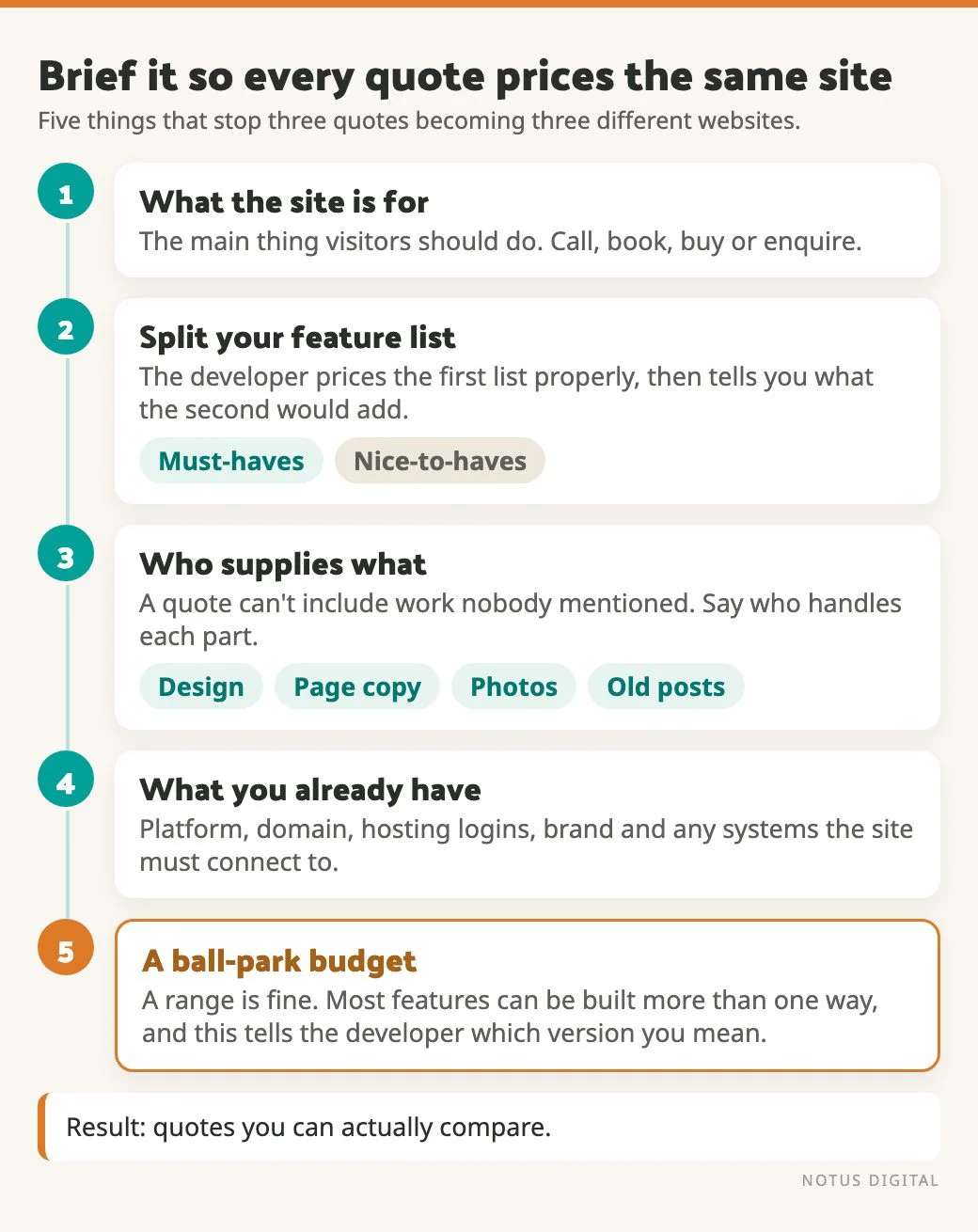
Most website features can be built more than one way. A booking system, a members area or a product filter can be an existing plugin set up well, or something built from scratch around exactly how you work. Both are legitimate. They just cost very different amounts, and a rough budget tells a developer which version you’re picturing.
Without it, whoever quotes is pricing a guess, and you might get a scary number for a site you never asked for. A quote that guesses low isn’t much better. The extras tend to show up once the build is under way.
A range is fine. “Somewhere between this and that” is plenty to work with. If you genuinely have no idea, ask for a couple of options at different levels. Our guide to how much a website costs in West Sussex is a reasonable place to get your bearings first.
When the brief and the budget don’t match
Sometimes a brief is a little hopeful for the budget behind it. That’s rarely anyone’s fault. A lot of the time the client simply doesn’t know what websites cost, and there’s no reason they should. It doesn’t help that prices vary a lot from agency to agency, depending on what they offer and how they work.
So we like to have an honest conversation about money early on, before anyone has designed anything. Once we know the budget, we can suggest something that properly fits it, and then work out how to get you as much as possible for what you’re spending. That conversation goes a lot better when the budget is already in the brief.
If you want to check your own brief first, a few signs it may be running ahead of its budget:
- A long list of features with nothing marked as essential.
- Words like “simple” or “just” sitting next to logins, bookings, payments or links to other systems.
- “Like a big brand’s site, but for us”, without saying which parts of that site actually matter to you.
The fix is to split your list in two: must-haves and nice-to-haves. A developer can then price the must-haves properly and tell you what the rest would add. You decide what goes in now and what waits for a second phase.
Who’s doing the design and the words?
A website job is usually several jobs in one. Design, words and the build are often separate pieces of work, and photography or SEO can sit on top. If some of that is coming from somewhere else, say so.
If you already have a designer, or you’re writing every word yourself, the build can be priced on that basis. If the brief doesn’t say, a careful quote has to assume something. One agency might assume it’s writing the copy and price it in, while another leaves it out because it assumed you were. The totals look miles apart. Nobody has done anything wrong.
Content deserves a line of its own in the brief. Who writes the page copy? Who supplies the photos? If there’s an old blog, who moves the posts across?
Spell out the complicated bits
Most of a brief can be short. The part that deserves real detail is anything unusual about how your business works.
When we built the site for Carnation Crafts, a paper craft retailer with thousands of products, they wanted how-to videos built into the site, showing how to use the products and what you can make, with new ones coming out regularly. They also ran daily deals and weekend deals. We talked the deals through with them in detail, because the rules behind them were complex to manage.
“A deals section” sounds small written down, so it’s the sort of thing that gets underpriced. Write it the way you’d explain it to a new member of staff, including who on your side sets the deals up each week.
What you’re starting from
This changes the job more than you might think. A useful brief mentions:
- Your current website platform, if you have one, and whether you’re happy with it.
- Where your domain and hosting live, and whether you can get hold of the logins.
- Any systems the site has to work with, such as a booking tool, a stock system or an email list.
- Your brand: logo, colours, fonts and any photos you own.
With Healing Textiles, a few plain facts settled it. There were about 20 products, they needed to be up and running quickly on a modest budget, and they were already on Shopify and knew how it worked. Those facts pointed to Shopify before anyone had drawn a page.
If you’re moving on from another developer, say whether they’ll provide a handover. On a recent site move, the previous developer’s handover covered the background and the issues they’d been working through, and it meant we could fix things quicker.
Custom build or plugin?
You don’t need to decide this in the brief. It helps to know how a developer thinks about it, though, because it’s a big part of where the money goes.
Our approach is to build as much custom as makes sense, and use a plugin where it earns its place. A plugin built for a common job usually gets updated every month. Something built from scratch can end up quite narrow, and it needs someone to keep it up to date. So custom work makes most sense where the feature is genuinely yours.
Plenty of quotes mix the two, so it’s worth asking each developer which parts of theirs are which.
Ask what happens after launch
A quote for a build covers the build. Once the site is live there’s always ongoing work: updates, security checks and someone making sure the contact form keeps delivering. Have that conversation at the start, so the running costs don’t arrive as a surprise later.
Testing is worth asking about too, because it takes time and time costs money. On a tighter budget, expect to do more of the testing yourself, and a good developer will tell you which parts.
If a quote doesn’t say what it leaves out, ask before you sign.
How to compare quotes that look different
Even with a good brief, quotes rarely line up neatly. Before you compare totals, check each one for:
- Whether design, content and build are all included, or only some of them.
- Which features are custom and which use plugins, and whether any plugin carries a yearly or monthly licence fee.
- Whether hosting, updates and support are included, and for how long.
- How much testing is in the price.
- How many rounds of changes are covered.
A much cheaper quote isn’t automatically a bad one. It’s worth finding out what it has left out, though. We’ve written more on the hidden cost of cheap web design if you want the longer version.
A simple website brief you can copy
- About your business: what you do and who your customers are.
- What the site is for: the main thing you want visitors to do, such as call, book, buy or send an enquiry.
- Must-haves and nice-to-haves, as two separate lists.
- The complicated bits, explained in plain English.
- What you already have: platform, domain, hosting, logins, brand and content.
- Who is supplying the design and the words.
- Sites you like, and what specifically you like about them.
- Your deadline, and whether it’s fixed or flexible.
- A ballpark budget or range.
- What you expect after launch: updates, support and changes.
That fits comfortably on a page or two. Nobody is expecting a novel. If you’d like to talk your brief and budget through with us, get in touch.
Questions people ask before sending a website brief
Yes, even as a rough range. Most features can be built more than one way, at very different costs, and a ballpark figure tells the developer which version you’re picturing. Without it, each developer has to guess, and their guesses rarely line up.
What your business does, what the site is for, your must-haves and nice-to-haves, a proper explanation of anything complicated, what you already have (platform, domain, hosting, logins, brand), who supplies the design and content, your deadline and a ballpark budget. It helps to mention what you expect after launch too.
A page or two is usually enough. Keep the general parts short and put the detail where the work is: anything unusual about how your business runs, such as deals, bookings or members-only content.
It depends on what you agree. You might write it yourself, use a copywriter or ask the agency to do it. Say which in the brief, including photos and any old posts that need moving, because quotes that assume different answers will look very different.
Check what each one includes before comparing totals: design, content and build, any plugin licence fees, hosting and updates, how much testing is in the price, and how many rounds of changes. A cheaper quote may simply have left something out.