


What should a contractor’s website include?
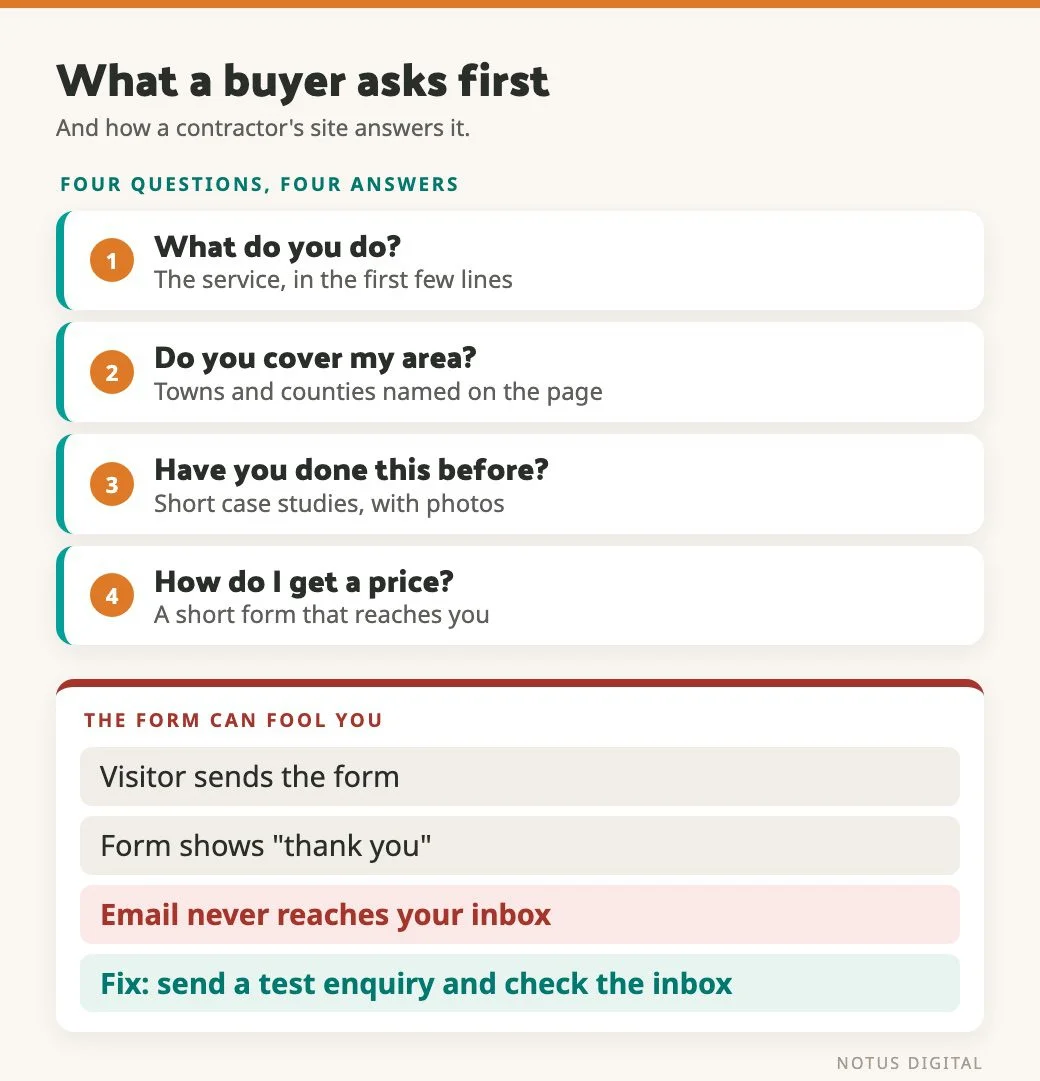
A contractor’s website has to answer the questions a buyer asks before they pick up the phone. What do you do? Do you cover my area? Have you done this kind of job before? How do I get a price?
Answer those clearly and you’re most of the way there. Then make sure the site is quick on a phone and every enquiry reaches you. Where small sites slip is the detail. A headline that could belong to anyone. A form that says thank you while the message goes nowhere.
We’re thinking here of owner-run firms that sell to other businesses. Specialist installers, testers, surveyors and the like. The firms a main contractor or a facilities manager calls in when a job needs someone who knows the work.
A contractor site we built in Littlehampton
EarthForce Lightning Protection is a specialist contractor based in Littlehampton. They found us by searching Google for web designers in Littlehampton and landing on our Littlehampton page. We tell that part properly in what West Sussex searches taught us about local SEO.
The brief was short. The owner wanted a better website, so that’s what we built. It went live on 11 August 2026, and it’s a small, fast, clear site with a working enquiry form.
One fix came just after launch. We sorted out the email authentication behind the form, the SPF and DKIM records that help a mail server trust messages sent from your domain. Without them, enquiries are more likely to land in spam.
Since launch the form has brought in genuine quote requests from other businesses. We won’t say who from. They’ve also given us a testimonial, and you can see the build in the EarthForce Lightning Protection case study.
Say what you do in the first few lines
Someone landing on your homepage should know within a few seconds what service you offer. Mission statements can go further down the page, or on the about page.
“Commercial roof repairs across West Sussex” tells a buyer more than “Building a better tomorrow” ever will. Less poetic, granted. It’s also the one that gets the phone call.
Use the words your buyers use. If they search for a “survey” and you call it an “assessment”, get both onto the page. A facilities manager comparing five firms in a lunch break won’t stop to translate.
If people search for your main services separately, give each one its own page. That gives you room to explain the job, who it’s for and what happens on site. It also gives search engines a clear page to show for that search, instead of one page trying to rank for everything at once.
Make your service area obvious
Contractors often cover a wide patch, and buyers want to know straight away whether you’ll come to them. Name the towns and counties you work in, and say if you’ll travel further for the right job. Put it where people look: the homepage, the contact page and the footer. Keep the wording the same everywhere.
Say where you’re based, too. Then, if you cover several towns, a page for each one is a fair first step. Proof that you’ve worked there, such as a case study or a review that mentions the town, does more.
Show the jobs you’ve already done
A business buyer is often spending someone else’s budget, and they’ll have to explain why they picked you. Evidence that you’ve done this kind of job before makes that easy for them.
A case study doesn’t need to be long. The type of site or building, the problem, what you did, a couple of photos and a line from the client if they’ll give you one. Mention the town. It helps a reader see you’ve worked near them, and in our experience it gives search engines the same signal.
Then add the smaller details that make a firm feel safe to hire:
- Accreditations and trade body memberships you hold, with logos linked to the body where you can.
- Your insurance cover, stated plainly.
- A named person to speak to, with a photo if you’re comfortable with it.
- Reviews or testimonials from real clients, with permission.
An enquiry form that asks the right things
The form is where a visitor becomes a lead, so it deserves more care than it usually gets. Ask for what you need to give a sensible first answer, and no more. Every extra field is one more reason to give up halfway.
Where the form sits matters too. If it’s tucked a long way down the page, some people won’t get that far.
For most contractors that looks something like this:
- Name, company, email and phone number.
- Where the job is. A town or postcode is plenty.
- A short description of what they need.
- How they heard about you. Make it optional. It’s still the cheapest marketing data you’ll collect.
Then make sure the enquiry arrives. That’s the job the SPF and DKIM fix did on the EarthForce site. A form can show its thank-you message while the email never reaches you, often because the site’s email isn’t set up to send properly, or your own email provider is blocking it. When you change the form or anything about your email, send a test enquiry and check it lands in the inbox, not just that the form said thanks.
For the quieter ways a form can fail, like a phone field that mangles UK numbers, see is your contact form really working?
Keep it quick on a phone
A lot of buyers will look you up on a phone, between meetings or sitting in the car park before a site visit. A page that takes an age to load, or a phone number they can’t tap, loses them.
The usual culprit is photos. A picture straight off a modern phone is far bigger than a web page needs, and a homepage with a dozen of them gets slow. Resize them before they go up.
Google’s free PageSpeed Insights tool will test a page on mobile and desktop and tell you what’s slowing it down. It won’t tell you whether your copy makes sense or whether anyone will enquire, so treat it as one check among several.
What you can leave out
Quite a lot, at least to start with. A contractor’s site does its job when it’s small and easy to follow. These can usually wait:
- A news or blog section you won’t keep up. A news page that went quiet years ago makes a visitor wonder if anyone is still answering the phone.
- Homepage sliders and heavy animation. They slow the page down and push what you do further down the screen.
- Pages for services you don’t really want to sell. They bring in enquiries you’ll only turn away.
None of this is off limits forever. Add things when there’s a reason to and someone to keep them up to date.
How to tell if your website is working
For a contractor, the number that matters is enquiries. Are quote requests arriving each month, and are they for the kind of work you want? Your own sense of how busy things have been counts too, so put it next to the figures.
If your form stores entries in the site, that count is more reliable than your analytics. On a site with a cookie banner, analytics mostly counts the visitors who accept.
When you compare, compare like with like. Put this month next to the same month last year, rather than next to last month, because many trades have busy and quiet seasons.
If the count has fallen, check how many of last year’s enquiries were spam before you call it a drop, and look at whether anything changed on the form or the page around it. The “how did you hear about us” answers give you a rough idea of which enquiries came through search.
Google’s free Search Console shows which searches your site appears for and which pages Google shows. It doesn’t show enquiries, but it’s a good way to see whether people are finding your service pages at all.
If you’re a contractor in this part of the world and your site isn’t pulling its weight, have a look at what we do for web design in Littlehampton. We’re happy to talk it through.
Contractor website questions
There’s no magic number. Most contractors need a homepage, a page for each main service people search for, a few case studies, an about page and a contact page. Add a page when people are searching for it or keep asking about it.
Enough to give a sensible first answer: name, company, email, phone, where the job is and a short description of the work. A “how did you hear about us” field is worth adding. Keep it short, because every extra field gives someone a reason to stop, and check the phone field accepts UK numbers.
If you sell to other businesses, they help a lot. A buyer wants to see you’ve done similar work before, and often has to justify their choice to someone else. Keep each one short, include photos, and mention the town. In our experience that helps both the reader and search engines.
Often by searching for the service and a town, then checking the first few sites they find. So the basics matter: a clear service, a clear area and proof you’ve done the work.
Enquiries first. Count the quote requests each month and compare with the same month last year, not just the month before. Your form entries are a more reliable count than Google Analytics, because on a site with a cookie banner Analytics mostly counts the visitors who accept. Search Console shows whether people are finding your service pages.