


What is a new client worth to a mortgage broker?
Grab last year’s case list and a calculator. The one on your phone will do. The number you’re after is what one new client is really worth to your firm, because that decides whether spending money on SEO makes any sense.
On a mortgage case there are two places the money can come from. The lender pays a procuration fee, and you may charge the client a fee of your own. How you charge decides what a case is worth, so your own figures beat anyone’s average.
Each lender sets its own procuration fee. One that publishes its rate, Nottingham Building Society, pays 0.40% of the amount borrowed on residential mortgages. Another lender will pay something different, so treat that as one data point and use the rates on your own panel.
The client fee is the easy bit. It’s whatever you charge, if you charge one, and you know that number already.
Advice on pensions or investments works differently. If you take an ongoing charge, one new client keeps paying for as long as they stay with you, so they’re worth a lot more than a single fee.
Whichever kind of firm you run, that figure is the one to keep in your head when someone tries to sell you a website. Us included.
When every visitor from Google already knows your name
We’ve seen this on more than one professional services site. Open Google Search Console and look at the searches that bring people in. If every one of them includes the firm’s own name, the site isn’t finding anyone new. Those people knew you existed before they typed a word.
That makes the site a business card. People who’ve already met you use it to find your number, and that’s about it. SEO is how you get found by people who need a broker and have never heard of you.
You can check your own site in a few minutes. Search Console lists the searches people used to find you. Split them into two piles: the ones with your firm’s name in and the ones without. Search Console hides some rarer searches for privacy, so the piles won’t add up to your total. The second pile is the new business that search is actually sending you.
Working it out from your own figures
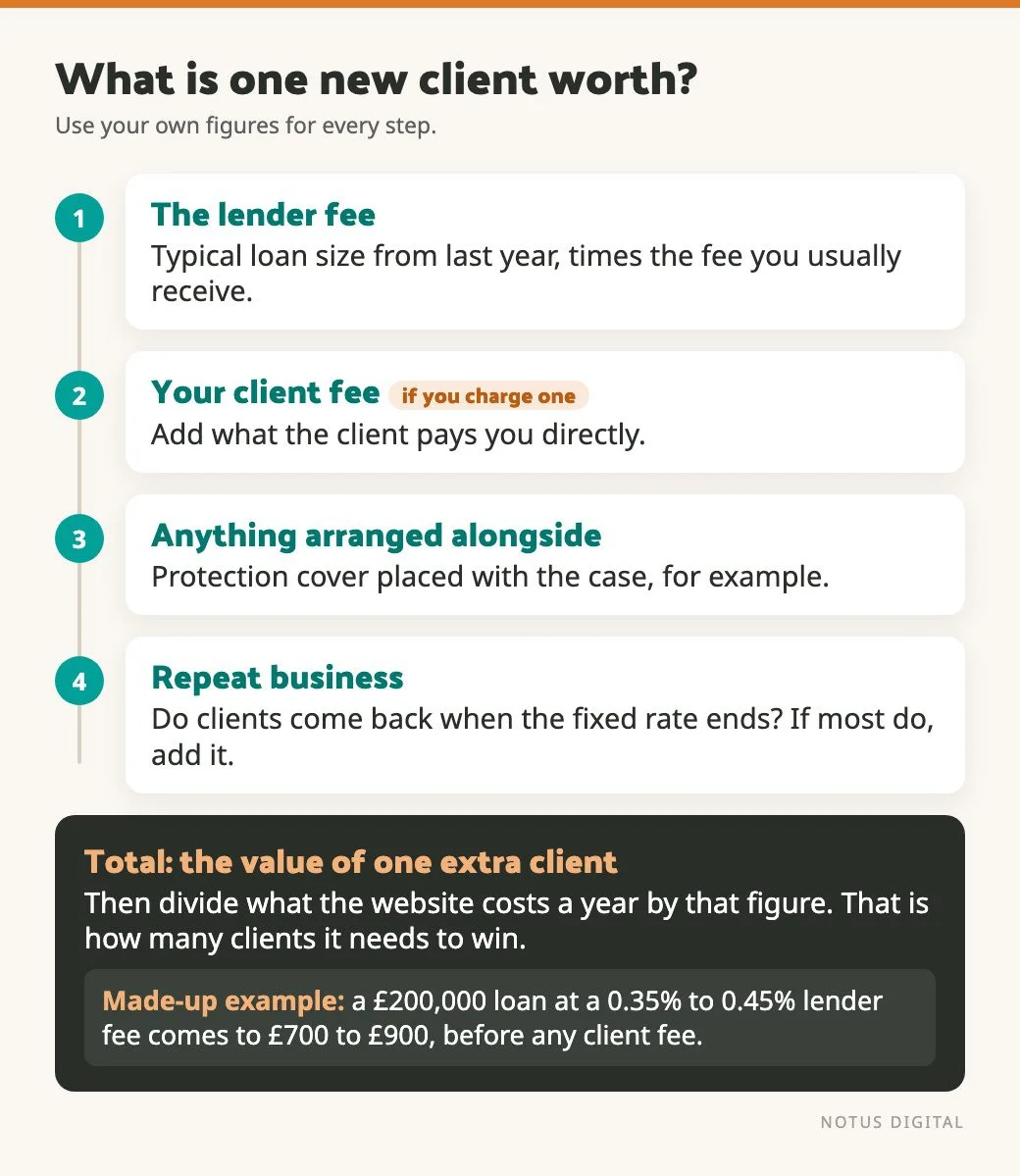
Your own figures will be more accurate than any average, and you already have them. Go through these in order.
- The lender fee. Take a typical loan size from your last year of cases and multiply it by the procuration fee you usually receive. If you’re with a network, use what reaches you after its share.
- Your client fee. Add it if you charge one.
- Anything you arrange alongside the mortgage. If you often place protection cover with a case, add what that typically earns you.
- Repeat business. When a client’s fixed rate ends, do they come back to you for the remortgage? If most do, one new client is worth more than one case.
Here’s a worked example. The loan size is a round number, so swap in your own. Take a £200,000 mortgage. At Nottingham’s 0.40%, the lender pays £800. Add your own client fee on top if you charge one. If you’re paid by the lender alone, £800 is the number to use.
Now stretch it. If the site brings in ten extra completed cases a year at £800 each, that’s £8,000. Put that next to what you pay for the site and its upkeep. Only count cases you wouldn’t have won anyway. Referrals and repeat clients don’t belong in this sum.
For pension and investment clients the sum runs over years. Multiply what a typical client has invested by your ongoing charge, then by the number of years clients tend to stay with you. Ignore growth, withdrawals and any initial fee to keep it simple.
How many enquiries do you need?
Now work backwards. Not every enquiry becomes a client. Some people won’t qualify, and others shop around and go elsewhere. Look back over the last year and work out roughly what share of your enquiries ended up as completed cases.
Then put the two together. Say, as a made-up example, one in four enquiries completes and a case is worth £800 to you. Each enquiry is then worth about £200. Divide what the site costs you each year by that, and you have the number of extra enquiries it needs to find just to pay for itself.
Do this sum before you talk to anyone about SEO. If the number of enquiries it needs looks silly for your area, that’s worth knowing before you spend anything.
Why a calculator can do better than a plain form
A contact form asks a visitor for something before giving anything back. Plenty of people browsing mortgage options aren’t ready to speak to a broker yet. They want a rough idea first. What could I borrow? What might the monthly payment be?
A calculator answers that on the spot. The visitor gets something useful first, so asking for a proper figure from a real person feels like the natural next step. In our view, that’s why calculators tend to turn more visitors into enquiries than a plain “get in touch” form. We can’t hand you a figure for it, because it depends on who visits your site.
A few things help a calculator do its job:
- Show the result before you ask for contact details. Someone who’s just typed in their numbers wants the answer first.
- Make the next step clear, something like “Want a figure based on your own situation? Book a call.”
- Keep the form that follows short. Every extra field is another reason to give up.
- Label the results as illustrative, and run the wording past whoever signs off your marketing.
What you can say on a regulated site
We aren’t compliance experts, and your compliance team or network has the final word. A couple of things are worth knowing before you plan any content, though.
The FCA’s mortgage rules in MCOB say a firm must take reasonable steps to communicate in a way that is fair, clear and not misleading. For promotions of regulated mortgages, MCOB 3A.3 also asks for them to be balanced, with no emphasis on the benefits without a fair and prominent indication of the risks, and to make clear where the credit is secured on the customer’s home. Check the current rulebook rather than relying on us, and ask your compliance contact what risk wording they want on your pages.
So don’t build your content around bold outcome claims. A line like “we saved our client thousands” is a headache waiting to happen. Useful explainers work better: what happens when a fixed rate ends, how lenders look at self-employed income, what a decision in principle is. People type those questions into Google.
How mortgage brokers and financial advisers get found by strangers
People looking for a broker usually search with a place in mind or a particular situation. “Mortgage broker near me.” “Mortgage for self-employed.” “First-time buyer mortgage advice.” Those are the searches that bring in strangers.
For the local side, a Google Business Profile, contact details that match everywhere they appear, and a page for each area you genuinely serve all help. Our practical guide to local SEO for service businesses walks through it. Reviews carry a lot of weight when someone’s choosing who to trust with a mortgage, so make asking for a Google review part of how you close every case.
For the situations, write a proper page or post on each one you’re good at. Self-employed applicants, contractors, later-life lending, buy-to-let. Whatever you actually do most of. Then back it up with the details that help someone trust a stranger with their mortgage: who you are, your FCA firm reference number, genuine reviews, a photo of an actual person.
Tracking an enquiry through to a client
None of this maths means much if you can’t tell which clients came from the website.
Set up key events in Google Analytics for form submissions and calculator use, so you can see which pages people enquired from. Bear in mind that Analytics only properly records visitors who accept cookies, so if your form plugin stores entries on the site, those are the more reliable count.
Then just ask. Put a “how did you hear about us?” question on the form, and ask the same thing on the first call. Note the answer against the case. After six months or so you’ll know how many completions started with a Google search, and what they were worth.
If you’d like help working out whether search could bring you new clients, bring your numbers and we’ll go through the sum together.
What brokers and advisers ask about the sums
It comes down to two of your own figures: what one new client is worth to you, and what share of enquiries turn into completed cases. Multiply those together to get what each enquiry is worth, then divide what the website costs you each year by that number.
On a mortgage case, through the procuration fee the lender pays, plus any fee the broker charges the client. Each lender sets its own procuration rate. Nottingham Building Society, for one, publishes 0.40% of the amount borrowed on residential mortgages. Your own mix of lender and client fees decides what a new client is worth to you.
In our view they tend to turn more visitors into enquiries than a plain contact form, because people get a rough answer before they’re asked for anything. That’s our experience. There’s no published figure for it, and it depends on your audience. Show the result before asking for details, keep the form after it short, and have your compliance team check the wording.
The FCA’s MCOB rules expect communications to be fair, clear and not misleading, and promotions of regulated mortgages to be balanced and clear where credit is secured on the customer’s home. Avoid bold outcome claims and stick to useful explainers. Your compliance team, network or principal firm has the final say, so get copy approved before it goes live.
Add key events in Google Analytics for form submissions and calculator use. Analytics only sees visitors who accepted cookies, so the entries your form plugin saves are the better count of real enquiries. Then ask every new client how they found you and note it against the case.